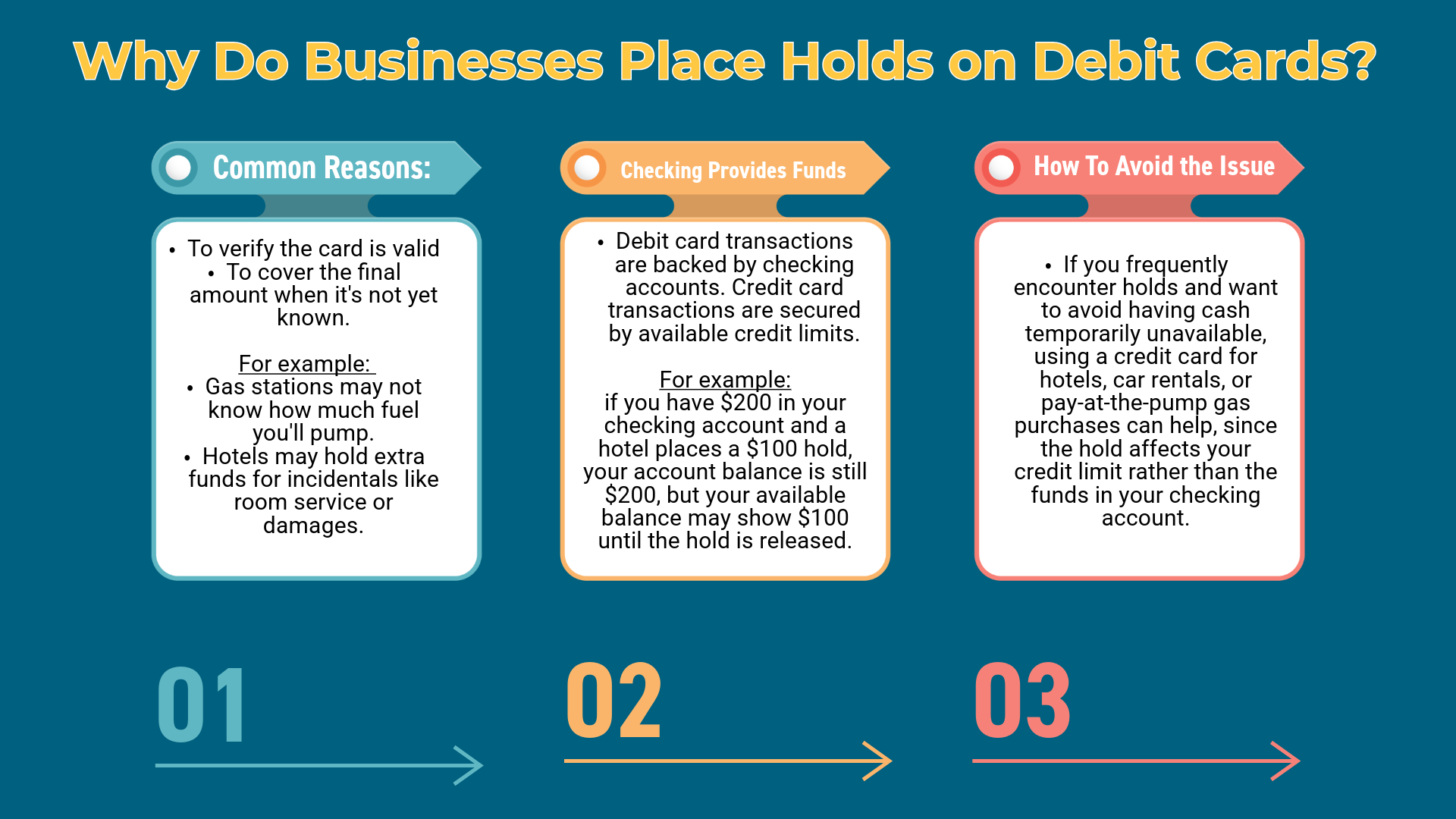
Businesses place holds on debit cards to make sure there are enough funds available before they finalize a charge. A hold is a temporary authorization—not the final payment—and it helps reduce the risk that the transaction will be declined later.
Common reasons include:
- Verifying the card is valid. A small authorization (sometimes $1 or another temporary amount) checks that the card is active and can be used.
- Covering the final amount when it's not yet known. Some businesses don't know the exact total at the time of authorization. For example:
- Restaurants may add a tip later.
- Gas stations may not know how much fuel you'll pump.
- Hotels may hold extra funds for incidentals like room service or damages.
- Car rental companies may hold funds for potential additional charges.
- Reducing financial risk. The hold reserves funds so the merchant is more likely to receive payment when they submit the final transaction.
With a debit card, the hold reduces your available balance because the money comes directly from your checking account. With a credit card, the hold reduces your available credit instead of tying up money in your bank account.
For example, if you have $200 in your checking account and a hotel places a $100 hold, your account balance is still $200, but your available balance may show $100 until the hold is released or replaced by the final charge.
If you frequently encounter holds and want to avoid having cash temporarily unavailable, using a credit card for hotels, car rentals, or pay-at-the-pump gas purchases can help, since the hold affects your credit limit rather than the funds in your checking account.
How long does a hold remain on a debit card?
A debit card hold (also called a pending authorization) typically remains on your account for 1 to 7 days, but the exact timing depends on the merchant, your bank, and the type of transaction.
Here are some common timeframes:
- Gas stations: Often 1–3 days, though some holds can last up to 7 days.
- Hotels: Can remain until checkout plus a few additional days (often 3–7 days after the final charge is processed).
- Car rental companies: May last for the entire rental period and several days afterward.
- Restaurants: Usually clear within 1–3 days after the final tip-adjusted amount is processed.
- Online purchases: If the merchant doesn't complete the transaction promptly, the hold may expire after several days, depending on your bank.
If the merchant submits the final charge before the hold expires, the hold is replaced by the completed transaction. If the merchant never completes the transaction, the hold eventually falls off and the funds become available again.
If a hold has been pending for more than a week, you can:
- Contact the merchant to confirm whether they completed or canceled the transaction.
- Contact your bank to ask when the authorization hold is scheduled to expire or whether it can be released early (some banks require the merchant to send a release).