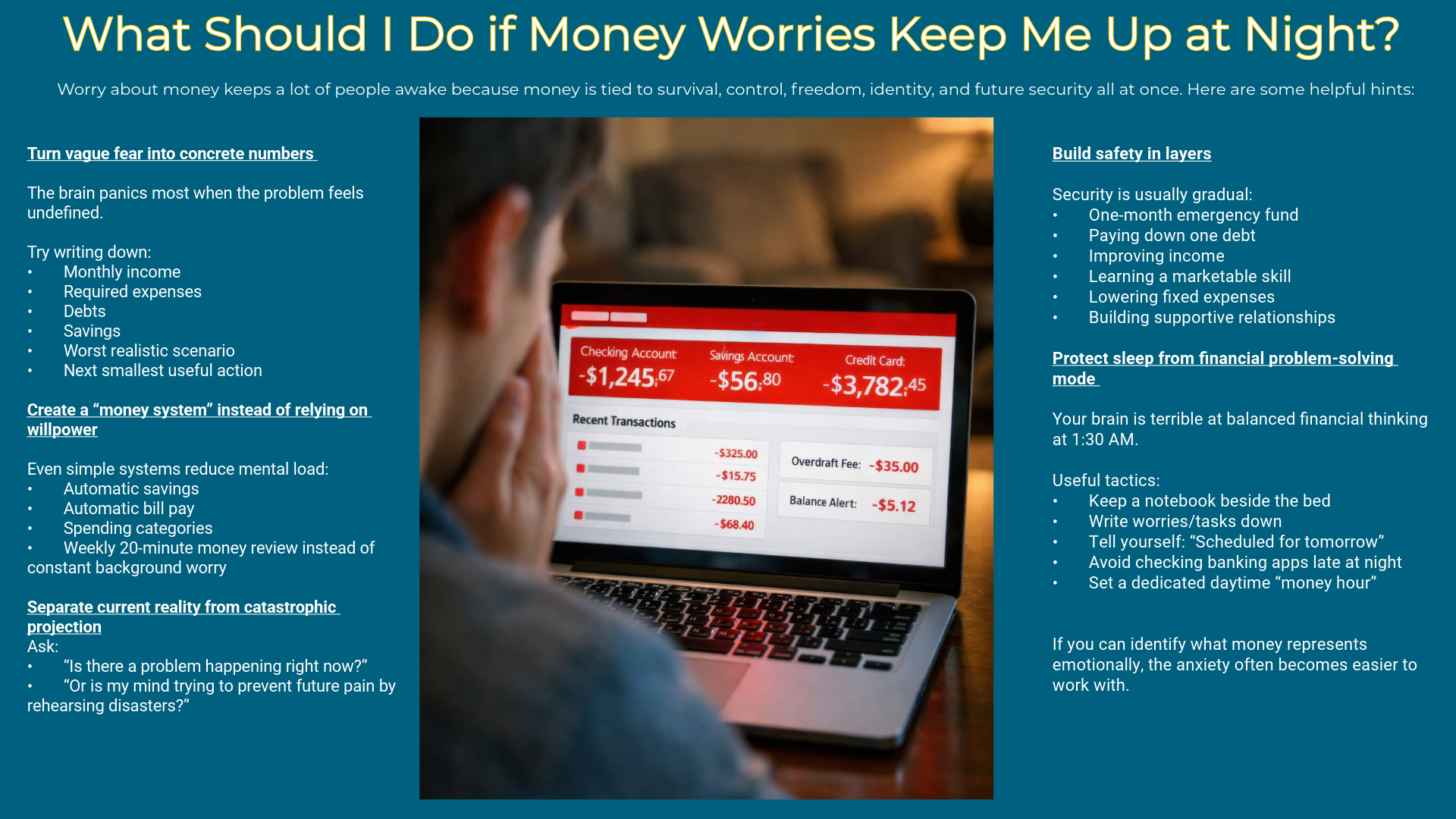
Worry about money keeps a lot of people awake because money is tied to survival, control, freedom, identity, and future security all at once. Your brain treats financial uncertainty less like an abstract math problem and more like a potential threat. At night—when there are fewer distractions—your mind starts running simulations:
- “What if I can’t handle an emergency?”
- “Am I falling behind?”
- “Did I make the wrong choices?”
- “Will this ever get easier?”
That loop activates stress hormones and makes sleep harder, which then makes the worries feel even more convincing the next day.
The “why” is usually a mix of a few things:
- Uncertainty — unclear income, debt, rising costs, unstable work, or no defined plan.
- Responsibility pressure — feeling like you must hold everything together.
- Comparison — seeing other people appear more financially secure.
- Past experiences — growing up around scarcity, instability, or conflict about money.
- Perfectionism or shame — believing you “should” already have it figured out.
A useful distinction:
- Some money anxiety is practical: bills, debt, lack of savings, unstable income.
- Some is psychological: even people with enough money can fear losing status, safety, or control.
The solution depends on which kind is driving you.
Here are the changes that tend to help most:
Turn vague fear into concrete numbers
The brain panics most when the problem feels undefined.
Try writing down:
- Monthly income
- Required expenses
- Debts
- Savings
- Worst realistic scenario
- Next smallest useful action
Often the fear shrinks once it has edges.
Create a “money system” instead of relying on willpower
Even simple systems reduce mental load:
- Automatic savings
- Automatic bill pay
- Spending categories
- Weekly 20-minute money review instead of constant background worry
A plan calms the nervous system more than optimism does.
Separate current reality from catastrophic projection
Ask:
- “Is there a problem happening right now?”
- “Or is my mind trying to prevent future pain by rehearsing disasters?”
That question alone can interrupt nighttime spiraling.
Reduce avoidance
Money anxiety gets louder when accounts, debt, or budgets are avoided. Small consistent contact usually lowers fear over time.
Five minutes facing the numbers is often more powerful than five hours worrying about them.
Build safety in layers
Security rarely arrives as one giant moment. It’s usually gradual:
- One month emergency fund
- Paying down one debt
- Improving income
- Learning a marketable skill
- Lowering fixed expenses
- Building supportive relationships
Your brain starts trusting the future when it sees repeated evidence you can handle problems.
Protect sleep from “financial problem-solving mode”
Your brain is terrible at balanced financial thinking at 1:30 AM.
Useful tactics:
- Keep a notebook beside the bed
- Write worries/tasks down
- Tell yourself: “Scheduled for tomorrow”
- Avoid checking banking apps late at night
- Set a dedicated daytime “money hour”
That trains your mind not to use bedtime as emergency planning time.
And one more thing: sometimes the fear isn’t actually about money. Money becomes the symbol your brain uses for:
- safety
- self-worth
- freedom
- fear of failure
- fear of depending on others
- fear of not having options
If you can identify what money represents emotionally, the anxiety often becomes easier to work with.