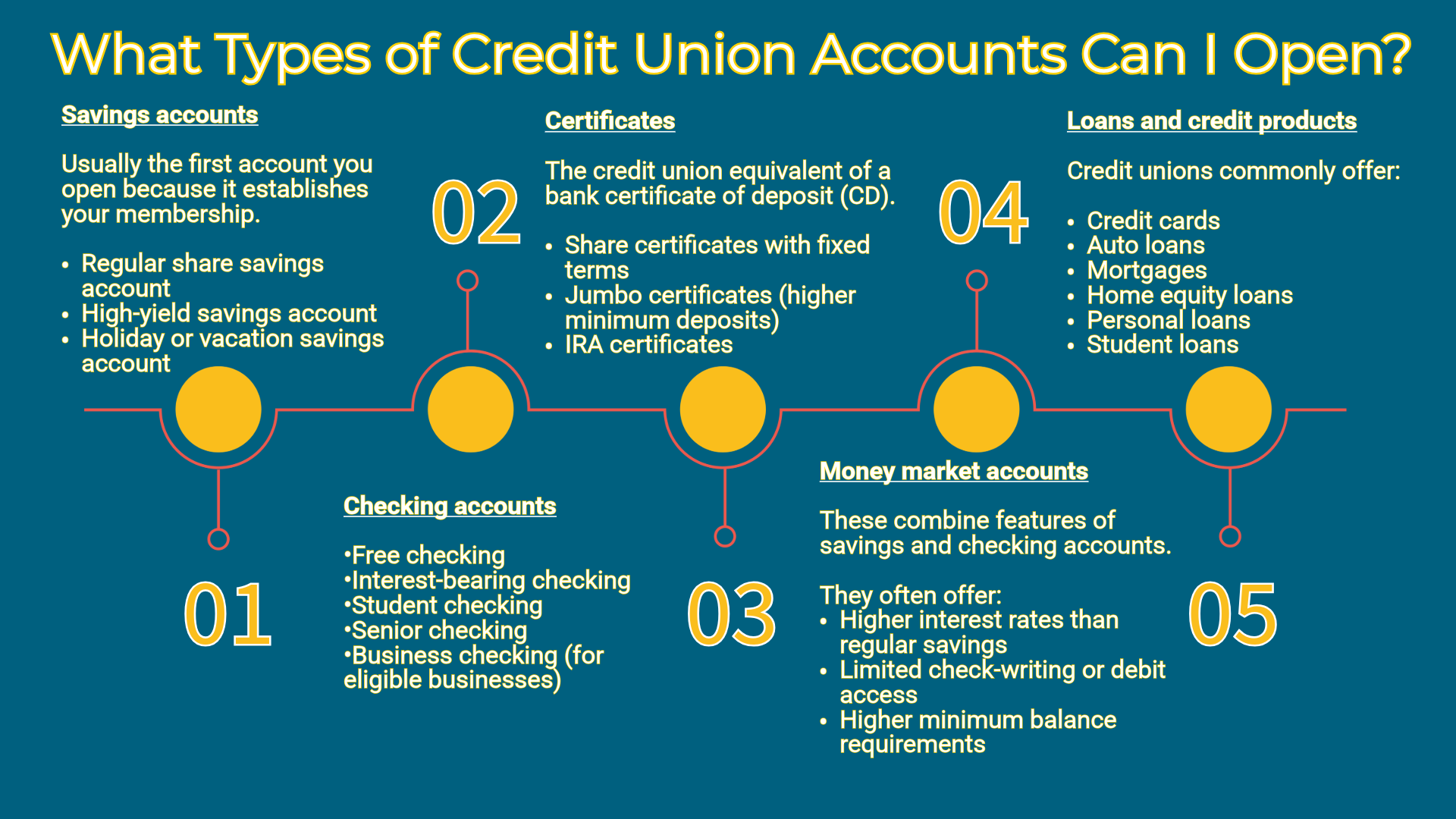
Most U.S. credit unions offer many of the same account types as banks, although the exact options vary by institution. Here are the most common types:
Savings accounts
These are usually the first account you open because it establishes your membership.
- Regular share savings account (the basic membership account)
- High-yield savings account
- Youth or teen savings account
- Holiday or vacation savings account
- Health Savings Account (HSA) (if offered and you're eligible)
Checking accounts
Used for everyday spending.
- Free checking
- Interest-bearing checking
- Student checking
- Senior checking
- Business checking (for eligible businesses)
Common features include:
- Debit card
- Online and mobile banking
- Bill pay
- Direct deposit
- Mobile check deposit
Certificates
The credit union equivalent of a bank certificate of deposit (CD).
- Share certificates with fixed terms (e.g., 6 months, 1 year, 5 years)
- Jumbo certificates (higher minimum deposits)
- IRA certificates
These typically offer higher interest rates in exchange for leaving your money untouched until maturity.
Money market accounts
These combine features of savings and checking accounts.
They often offer:
- Higher interest rates than regular savings
- Limited check-writing or debit access
- Higher minimum balance requirements
Individual Retirement Accounts (IRAs)
Many credit unions offer retirement savings accounts, including:
- Traditional IRA
- Roth IRA
- SEP IRA (for self-employed individuals and small businesses)
These may be invested in savings or certificate products, depending on the credit union.
Business accounts
If the credit union serves businesses, you may find:
- Business savings
- Business checking
- Business money market accounts
- Business certificates
Trust and specialty accounts
Some credit unions also offer:
- Trust accounts
- Estate accounts
- Custodial accounts under the Uniform Transfers to Minors Act (UTMA)
- Custodial accounts under the Uniform Gifts to Minors Act (UGMA)
- Joint accounts
- Payable-on-death (POD) accounts
Education savings
Some credit unions offer:
- 529 college savings plan access through an investment partner
- Youth savings accounts designed for education goals
Loans and credit products
While not deposit accounts, credit unions commonly offer:
- Credit cards
- Auto loans
- Mortgages
- Home equity loans and lines of credit
- Personal loans
- Student loans
Membership requirements
Unlike banks, credit unions require membership. You may qualify through:
- Where you live
- Your employer
- A family member
- Membership in a qualifying organization
- Military service or veteran status (for some credit unions)
Many credit unions have broad eligibility, making it easy for most people to join.
Deposit insurance
Deposits at federally insured credit unions are protected by the National Credit Union Administration through the National Credit Union Share Insurance Fund (NCUSIF) for up to $250,000 per depositor, per ownership category, similar to deposit insurance at banks.
The National Credit Union Administration was established in 1970 to mirror the financial stability provided by the FDIC. This independent federal agency oversees the system of cooperative financial institutions. The NCUA insures member deposits, often referred to as shares, at federal credit unions and the majority of state-chartered credit unions.
Insurance coverage is provided through the National Credit Union Share Insurance Fund (NCUSIF). The NCUSIF collects required premiums from participating credit unions to protect member deposits.