Building flexibility into a financial plan is less about predicting every future event and more about designing systems that can absorb change without derailing your goals. A resilient plan usually combines liquidity, adaptable spending, diversified income/assets, and regular reviews.
Here are the most effective ways to make your financial plans flexible:
Separate “Core Stability” from “Optional Growth”
Think of your finances in layers:
- Core layer: housing, insurance, emergency savings, retirement basics
- Flexible layer: travel, luxury purchases, aggressive investing, side projects
This structure lets you reduce discretionary spending during life changes without jeopardizing essentials.
Maintain a Strong Emergency Fund
A flexible plan needs cash reserves.
Typical targets:
- 3–6 months of expenses for stable dual-income households
- 6–12 months if self-employed, single-income, or in a volatile industry
Keep it somewhere liquid and safe, such as a high-yield savings account.
This protects against:
- Job loss
- Medical issues
- Relocation
- Family changes
- Unexpected repairs
Avoid Overcommitting to Fixed Expenses
High fixed costs reduce adaptability.
Watch for:
- Oversized mortgages or rent
- Large car payments
- Excessive subscriptions
- Debt-heavy lifestyles
A useful benchmark:
- Keep mandatory monthly obligations low enough that your plan still works if income temporarily drops.
Build Multiple Income Streams
Flexibility increases when all income doesn’t depend on one source.
Examples:
- Side consulting
- Freelance work
- Rental income
- Dividend investments
- Small online businesses
- Professional certifications that improve employability
Even modest secondary income can create breathing room during transitions.
Diversify Investments by Time Horizon
Match money to when you may need it.
Example structure:
- Short-term (0–3 years): cash, treasury funds
- Medium-term (3–10 years): balanced investments
- Long-term (10+ years): growth-oriented assets
This reduces the chance you’ll need to sell long-term investments during a downturn because of a life event.
Use Scenario Planning
Instead of making one “perfect” plan, prepare for several realistic possibilities.
Ask:
- What if my income drops 20%?
- What if I move cities?
- What if I have children?
- What if I want a career break?
- What if I need to support parents?
You don’t need exact answers — just rough contingency plans.
Review Insurance Regularly
Insurance is what keeps one life event from becoming a financial crisis.
Key areas:
- Health insurance
- Disability insurance
- Life insurance (if others depend on you)
- Home/renters insurance
- Umbrella liability coverage for higher net worth households
Update coverage after major life changes.
Keep Debt Strategic, Not Burdensome
Not all debt is bad, but inflexible debt is risky.
Prioritize:
- Reasonable debt-to-income ratios
- Fixed-rate borrowing when appropriate
- Accelerated payoff of high-interest debt
Avoid relying on future income growth to make current obligations manageable.
Revisit Your Plan Regularly
A flexible plan is a living system.
Review:
- Quarterly for budgeting/cash flow
- Annually for investments and goals
- Immediately after major life events
Common triggers:
- Marriage/divorce
- New child
- Career change
- Move
- Inheritance
- Health changes
Focus on Financial Capacity, Not Just Net Worth
Many people optimize for maximum returns but ignore resilience.
Useful metrics include:
- Savings rate
- Liquidity
- Low fixed expenses
- Employable skills
- Geographic flexibility
- Stress-tested budget
A slightly less optimized plan that survives disruption is often better than an aggressive plan that breaks under pressure.
A Practical Framework
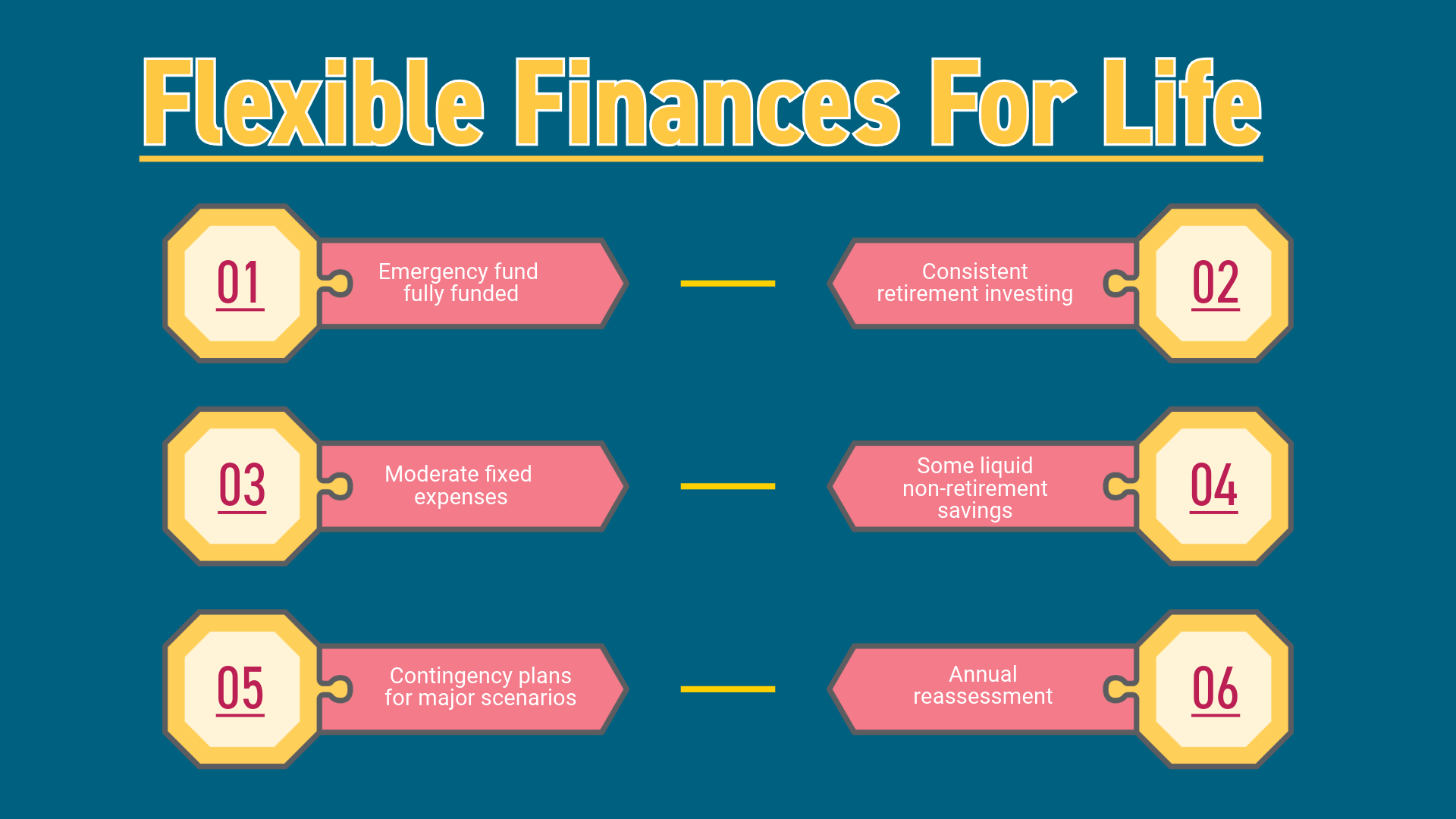
A flexible financial plan often looks like:
- Emergency fund fully funded
- Moderate fixed expenses
- Consistent retirement investing
- Some liquid non-retirement savings
- Insurance coverage updated
- Contingency plans for major scenarios
- Annual reassessment
That combination gives you room to adapt when life changes without starting over financially.