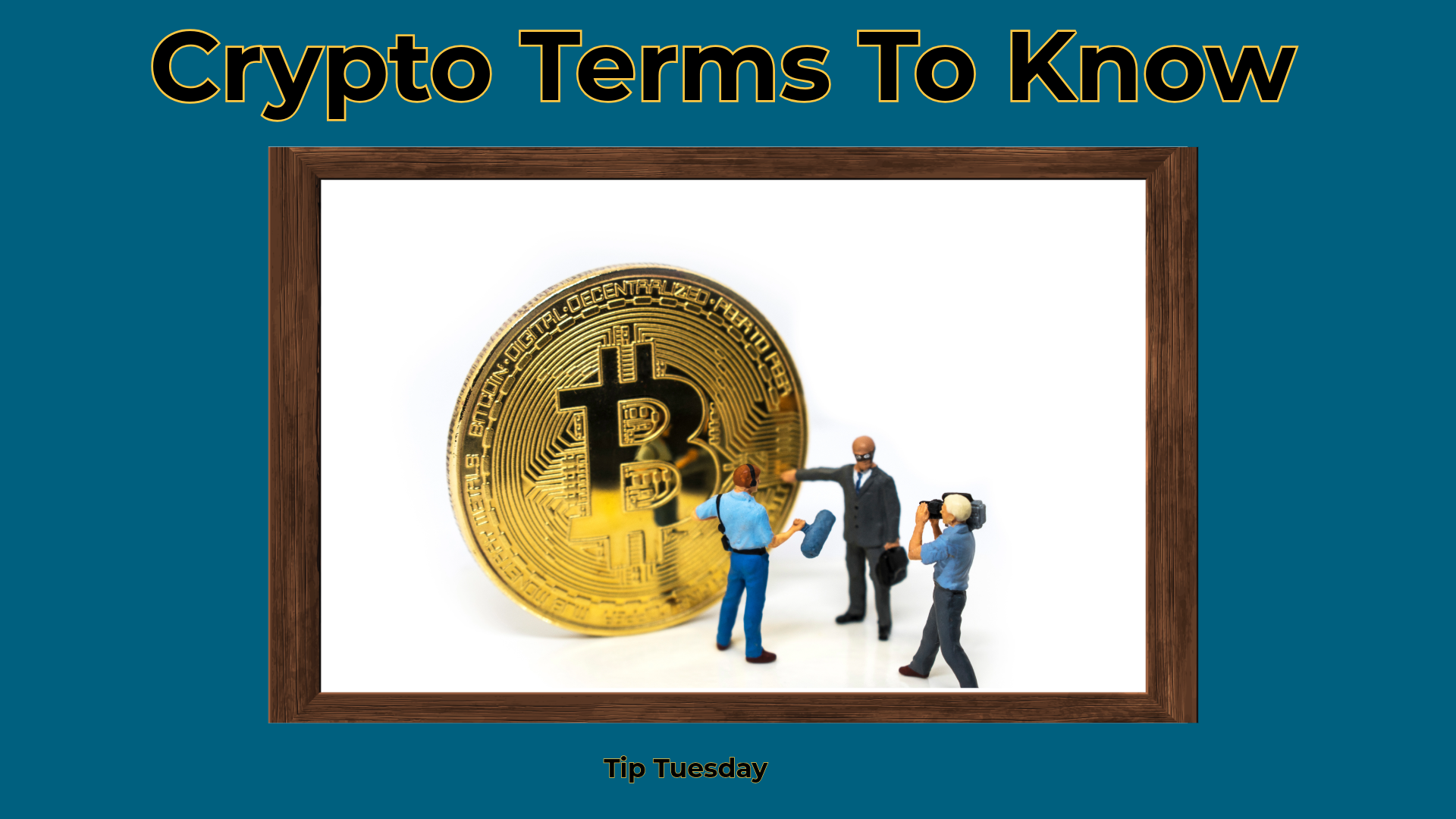
Don’t know your blockchain from your Bitcoin? Never fear. Here are the essential crypto terms to know.
Core Cryptocurrency Terms
Blockchain
- A decentralized digital ledger that records transactions across many computers so the data can’t be altered. Blockchains are used as a bookkeeping ledger by cryptocurrencies, stablecoins, tokenized deposits, non-fungible tokens (NFT), student grades and in supply chain management to provide only a small list of users.
Cryptocurrency
- Digital or virtual money that uses cryptography for data security (e.g., Bitcoin, Ethereum)
Decentralization
- No single entity (like a bank, government, corporation, or administrator) controls the network.
Wallet
- A tool (app, hardware device, or software) that stores your private and public keys so you can send and receive crypto or other interactions programmed into your wallet
Private Key
- A secret code that proves ownership of your crypto. Often this is a long alpha numeric number or a grid of several words (see seed phrase). Regardless of how your private key is represented, it is critical you know where you have stored your private key and that no one else has access to it.
- If someone gets this, they control your money or anything else you have stored on a digital wallet
Public Key / Address
- Your “account number” used to receive crypto. The PUBLIC key is safe to share.
Exchange
- A platform (software driven collection of interests) where you buy, sell, or trade crypto (Coinbase, Binance, etc.). Different platforms may perform differently, thus confirm if you are expecting fiduciary standards, an advisor, or simply a price.
Nodes
- Nodes are components of a blockchain network, maintaining the latest record of transactions and ensuring network rules are adhered to.
- Nodes can be of different types, each with specific roles, such as validating transactions or creating new blocks.
- Anyone with the appropriate technology and commitment may set up a node, potentially contributing to the decentralization and security of the blockchain.
Sidechain
- Sidechains are separate blockchain networks that connect to a parent blockchain, aiming to enhance its scalability and interoperability.
- They utilize a two-way peg mechanism to facilitate the transfer of digital assets between the parent blockchain and the sidechain.
Investment-Related Terms
Market Cap
- Total value of a cryptocurrency (price × number of coins).
Altcoin
- Any crypto other than Bitcoin.
Stablecoin
- Cryptos pegged to a stable asset like the U.S. dollar (USDC, USDT). The GENIUS Act will soon require all payment stablecoins to be regulated by the state or federal government.
Token
- A digital asset built on another blockchain (like ERC-20 tokens on Ethereum).
Staking
- A pledge of value (crypto) to guarantee that a node will perform duties as expected. If the node is slow to process data or provides what is later found to be inaccurate data, the stake is forfeited. When pooled, staking reflects a time commitment, giving up the liquidity of the crypto in exchange for another entity to use their crypto to perform blockchain transactions. Giving up the use of crypto for a period of time is often rewarded with earnings.
Liquidity
- Both a reflection of who will buy the crypto to be sold and how easily you can buy or sell an asset without affecting its price.
Gas Fees
- Transaction fees paid on some blockchains (especially Ethereum).
Security Terms
Seed Phrase / Recovery Phrase
- A list of 12–24 words used to restore your crypto wallet.
- Never share this. Ever.
Cold Wallet
- An offline network wallet (USB-like device). Some consider this the safest way to store crypto long-term.
Hot Wallet
- Online or app-based wallet. Convenient but more hackable; yet confirmable that you are in fact the holder of the asset.
Rug Pull
- A scam where project developers promote an “opportunity” and then disappear with investors’ money.
Phishing
- Scammers impersonating legitimate sites to steal your crypto, identify, or anything of value.
Technical / Advanced Terms
Proof of Work (PoW)
- A validation method requiring computing power (used by Bitcoin).
Proof of Stake (PoS)
- A validation method where validators stake coins (used by Ethereum).
Proof of History
A validation method where validators compare past transactions (used by Solana).
Smart Contract
- Self-executing code on the blockchain (e.g., automated loans, trades). Very similar to automated payments with the exception that the bank may not be involved and the number of conditions may be significantly more than simply the day of the month.
DeFi (Decentralized Finance)
- Financial services using representation of value identified by blockchain tokens instead of banks (lending, trading, etc.).
Non-Fungible Token (NFT)
- Unique digital asset stored on a blockchain (art, collectibles).
DAO (Decentralized Autonomous Organization)
- Member-run organization governed by smart contracts instead of managers.
Crypto Culture Terms
- HODL — Hold long-term through volatility.
- FOMO — Fear of Missing Out.
- FUD — Fear, Uncertainty & Doubt.
- Whale — Investor with huge holdings.
- Pump & Dump — Inflate price then mass-sell.
Buying & Trading Terms
- Exchange — Platform to buy/sell crypto.
- CEX (Centralized Exchange) — Managed by a company.
- DEX (Decentralized Exchange) — Peer-to-peer trading.
- Gas Fees — Network transaction fees.
- Market Cap — Total value of a crypto asset.
- Volatility — How rapidly prices change.
- Liquidity — How easily assets trade without price impact.